It hit 40°F in Florida and I put a sweater on Sage. Within minutes she stopped stirring up drama, found the couch, and turned into a cuddle dog. Here’s what I think is happening, what the science says (as much as it can), and what to watch for if your Shiba seems to “calm down” in clothes.
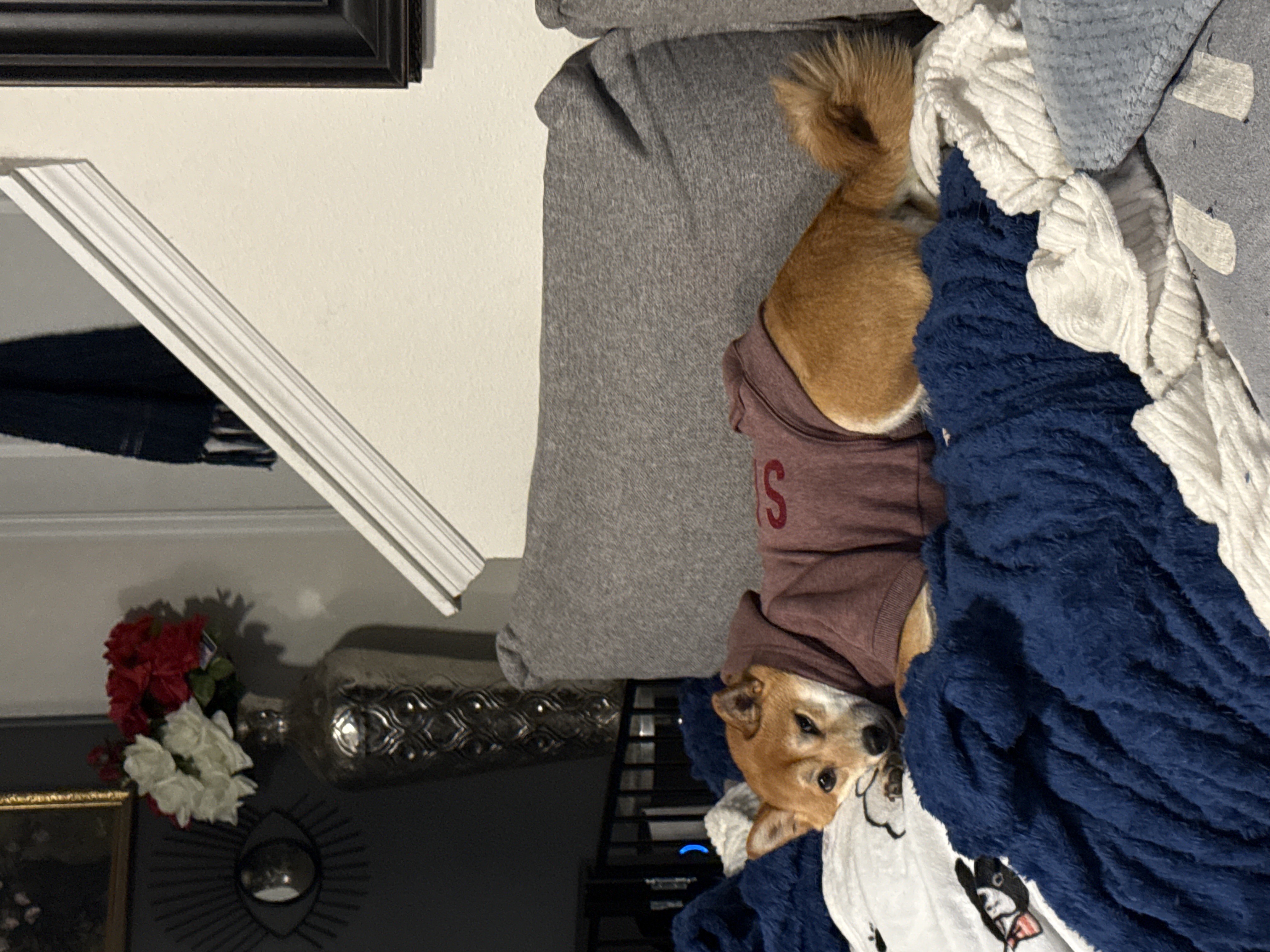
Sage: sweater on, couch claimed, chaos paused.
It was about 40 degrees out. Cold for Florida. Cold enough that I could feel it in my house, and Sage looked like she felt it too. So I put a sweater on her. Nothing fancy. Not a costume. Just a sweater.
And then she changed. No pacing. No “let me antagonize my sisters for sport.” No constant motion. She climbed onto the couch and curled up like it was her mission. Later she crawled into my lap and started giving me kisses. Calm, soft, settled.
My working theory: the sweater is doing two things at once: (1) reducing cold discomfort and (2) adding light, steady pressure that helps her nervous system downshift.
Shibas have a double coat, so they’re often labeled “cold-weather dogs.” But that’s not the whole story. What matters in real life is the dog in front of you: size, body condition, age, health, where they live, and what they’re acclimated to. A Shiba raised in Florida can still be a Shiba, and still act like 40°F is rude.
If Sage was mildly cold, she would be spending energy staying comfortable. Cold stress can look like restlessness. When you remove that discomfort, you don’t just get “a warm dog.” You can get a dog whose baseline irritation drops. Less discomfort can mean less reactivity, less pestering, less picking fights.
There’s a reason products like ThunderShirt exist. They’re based on the idea that gentle, sustained pressure can reduce arousal in some dogs. The evidence isn’t “magic cure” level, but research and clinical use suggest that compression can help certain dogs settle during stress. For some dogs, clothing can function like a mild, full-body “hug” that makes the world feel more predictable.
If Sage is the kind of dog who runs hot mentally (busy, spicy, always scanning), the sweater might be adding just enough sensory input to help her downshift. Not shut down. Not freeze. Just soften.
This is the downside possibility, and it’s real. Some dogs “calm down” because they’re uncomfortable. Not because they’re regulated, but because they’ve learned they can’t move normally or they feel restricted.
Here’s how I tell the difference with Sage:
My rule: if the sweater goes on, I check fit, watch behavior, and I don’t leave it on unattended for long stretches.
Based on what I saw, I don’t think she “hates it.” I think it helps her. The sequence matters: sweater on, body relaxes, she chooses the couch, she initiates affection. That looks like comfort, not resignation.
Also, this matters: Sage is not sedated. She’s not shut down. She’s just… not starting fights for entertainment. Which is honestly kind of amazing.
PM Note: So, the day has come and gone since I first put the sweater on. That was this morning. We took it off when it warmed up and Sage has gone about her day. A few moments ago she was antagonizing her baby sister and I reached over and picked up the little doggie hoodie and asked sweetly in that I-talk-to-dogs-in-baby-voice tone "Sage, do you want to put your sweater on?" 100% yes, she did. She sat in front of me eagerly and put her head in the head hole as I held it open to see if she actually 'wanted' to. She is now sleeping next to me.
Dog behavior research on pressure garments is mixed, but there is credible discussion and study around anxiety wraps and the use of pressure as a calming input. These are a few starting points you can read:
If you want, I can convert those bullet points into a formal bibliography with specific citations, but I need to know if you prefer veterinary sources (Merck/MSD, AAHA, ACVB-style) or studies only.
I don’t care about dog sweaters as fashion. I care about what my dog is telling me. And today Sage told me that warmth plus a little pressure equals peace.
Written by Shannon, Founder of Shiba Saviors™.